
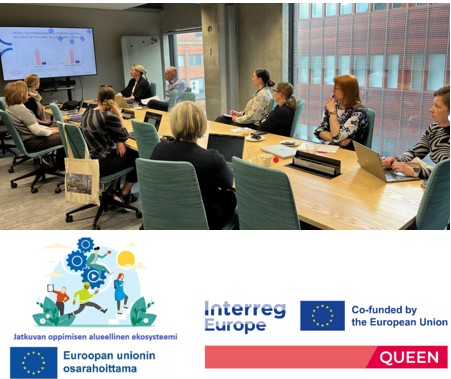
Working life has become increasingly uncertain, making it harder for young people to secure internships, apprenticeships or jobs. These challenges were discussed by regional business organisations, education providers and employment actors at a joint event organised by the QUEEN and JOE projects in April.
According to business survey insights presented by the Turku Chamber of Commerce, recruitment activity is expected to remain low across most sectors, although slight improvement is visible in industry. Construction and retail remain weak, while summer job opportunities are increasing in industry, construction and services but declining in retail.
Companies identified weak demand and geopolitical uncertainty as key constraints. At the same time, around one-fifth reported shortages of skilled labour, particularly in industry and services.
A central challenge is the limited capacity of companies to mentor and onboard young people. Employers increasingly expect “job-ready” candidates, highlighting the need for closer collaboration between education providers and businesses. Better alignment of skills with labour market needs during studies would ease transition into employment.
Education providers also play a critical role in strengthening students’ resilience and creating realistic expectations about working life. Continuous dialogue between employers and students is essential to bridge expectation gaps.
Limited job opportunities – new forms of cooperation needed
Strategic partnerships between educational institutions and companies are key but need to evolve. Traditional forms such as internships, apprenticeships and thesis projects remain important, alongside company visits and joint activities.
In the current economic situation, alternative models are emerging:
- Part-time internships
- Short development projects
- Innovation workshops organised by educational institutions
- Joint participation in events
These flexible formats can maintain cooperation even when full-time placements are scarce. Long-term planning and communication also help companies signal when recruitment opportunities may reopen.
Ensuring quality in work-based learning
The QUEEN project focuses on improving the quality of apprenticeships and work-based learning. Regional analysis shows that, overall, work-based learning is of good quality, but there are inconsistencies in supervision practices and limited awareness among employers about different learning pathways.
There are also open questions related to apprenticeship wage structures and compensation models.
International students face particular challenges: they are often the first to be affected when internship opportunities are limited. Increasing visibility of their skills and success stories is seen as essential to improve their employment outcomes.
The event was organised jointly by the JOE and QUEEN projects, both co-funded by the European Union.